Chicago Public Schools enrollment has declined once again by another 11,500 students to about 304,700, officials said Thursday in announcing preliminary data, the lowest number in more than two decades.
Enrollment had stabilized for two years — even increasing briefly — with the arrival of thousands of immigrant students in 2023 and 2024. But the trend proved short-lived as the district’s 20-year enrollment freefall resumed last year and again this fall, dwindling from its high of nearly 439,000 students in the 2002-2003 school year.
Declining enrollment — and, subsequently, underenrolled schools — have become a key issue in the city’s first-ever school board president race as some candidates suggest revisiting school closures. The district has a moratorium on closings until after this school year. Community groups rallied Thursday morning to call for the prohibition to be extended.
CPS officials are pointing to declining birth rates locally, nationally and globally, in addition to families leaving the city for the suburbs and immigrant population declines spurred by President Donald Trump’s aggressive deportation policies.
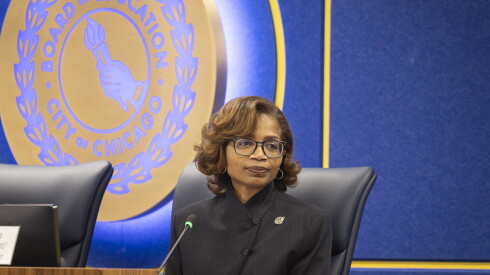
“Here’s the bottom line: What we control is the quality of education and experience that we provide our students,” CPS Supt./CEO Macquline King told the Board of Education in its monthly meeting Thursday. “That’s what our families care about, and that has been my focus as superintendent/CEO.”
King said the silver lining is that, despite another decline, CPS has regained its status as the nation’s third-largest public school system.
“I know, it’s like winning because someone tripped, but we are the third largest district in the country again,” she said.
Longtime and widespread trends
Leaders tried to contextualize the declines by showing that public school enrollment is falling nationwide, particularly in large urban districts. From 2014 to 2024, the most significant enrollment losses have happened in Los Angeles, Houson, Chicago, Dallas and Philadelphia, according to data presented by CPS officials.
Illinois has also lost about 200,000 public school students statewide, or 10%, since 2017.
Anniese Lewis, the deputy chief education officer at CPS, said districts still have not recovered from steep declines during the COVID-19 pandemic.
Lewis cited falling birthrates nationally that are “even more pronounced here in Chicago.”
In 2005, there were about 45,000 births in Chicago. That fell by more than 40% to around 27,000 in 2023. The district’s kindergarten cohort has shrunk by the thousands.
“Most recently, we’ve dipped below the national average,” Lewis told the board Thursday.
The district has 450,000 available seats in its schools with 455,000 school-age children in Chicago in 2024, the year with the most recent count. With the share of Chicago students enrolled in private school or classified in census data as “not enrolled” — which includes children who are homeschooled, have dropped out or are in between schools — slightly increasing, CPS has been left with more empty seats.
Between 2008 and 2018, CPS served roughly 75% of the city’s school-age population. By 2023, that had fallen to 71%, according to a report from the advocacy group Kids First Chicago.
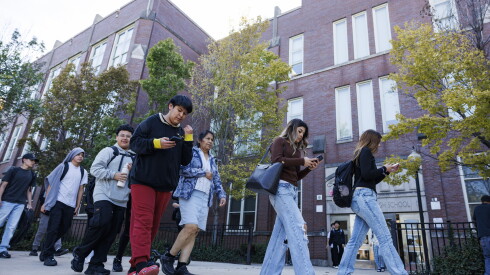
The biggest declines over the past decade have been in some of Chicago’s immigrant community hubs, such as Pilsen, Little Village, Avondale, Brighton Park, Gage Park and McKinley Park — in some cases seeing as dramatic of decreases as 53% in the past decade, according to CPS.
“There has been a rapid gentrification leading to a steep decline in [the] youth population. Multigenerational family homes are being converted to single-family homes, reducing the availability of family housing,” Lewis said. “[And] there has been an exodus of working class families who are moving to the outer suburbs for single family homes and perceived safety.”
Those trends were apparently accelerated by the Trump administration’s damaging deportation campaign last fall. Some students were detained, and federal activity around schools stoked fear in immigrant communities. There were spikes in absenteeism among English language learners who chose to stay home during enforcement actions. Some families considered leaving the city to escape the threat.
“While the U.S. experienced an influx of new arrivals in 2023 and 2024, this trend has now reversed dramatically,” Lewis said. “We are all familiar with the changes in immigration policy and enforcement at the federal level. Fewer people are coming into the US and more are leaving.”
At Kelly College Prep in Brighton Park, enrollment this year fell by 229 students to 1,273, according to preliminary data.
Meanwhile in the past 10 years, CPS enrollment has increased, in some cases significantly, around more affluent areas such as O’Hare, the Loop, Lincoln Park, North Center, Near South Side and Kenwood.
Demographics unchanged
The share of Latino, Black, white and Asian American students remained roughly the same among the 304,687 students enrolled at CPS on the 20th day of the school year, when the district takes its annual count.
The share of students in special education grew again, up to 18.4% of CPS. But the district counted slightly fewer students who are in poverty, experiencing homelessness or learning English — though officials said those numbers typically go up after the start of the school year as students’ needs are identified.
Charter and contract schools saw slightly steeper enrollment declines than district-run schools, in part because five former Acero charter schools and ChiArts transitioned to traditional CPS schools.
School closings and the board president race
Ever since the highly controversial and historic closing of 50 schools by former Mayor Rahm Emanuel in 2013, closures have been a third-rail policy that most leaders have avoided suggesting.
But those conversations have reignited in this year’s school board president race, with three of four candidates indicating or outright saying they would consider school closings.
One candidate, Victor P. Henderson, responded to a WBEZ, Sun-Times and Chalkbeat candidate questionnaire that he would be open to closing schools “as an extraordinary last resort.” Sendhil Revuluri said he also would be willing to close schools to improve the experiences of students in schools that have become too small to meet their academic and social needs.
Challenger and current board member Jessica Biggs declined to say yes or no, instead saying closings should be the “last thing” leaders propose but that “budget pressure is real.” Only Hilario Dominguez, backed by the Chicago Teachers Union, said he would oppose school closings.
Evidence has shown that the 2013 closings didn’t lead to lower costs, better outcomes for students or improved conditions in communities, the Sun-Times and WBEZ found in an investigation a decade later.
“We’ve got 25 years worth of data that demonstrates the harm done by closing schools and the people targeted when schools close,” said board member Jitu Brown, who participated in a hunger strike in 2015 to save a South Side school from closing. “Over 80% of the school closings across the United States have happened in Black neighborhoods. That means Black communities targeted. And so I’m humbly asking us to be different — to look at schools that are deemed underutilized with a different lens, as an opportunity.
“I’m hopeful that [closing schools] is not what’s on the table.”
Contributing: Nicole Jeanine Johnson