Landing a stadium deal for a professional sports team is a delicate proposition for any elected official.
Nobody wants to give the farm away to a multibillion-dollar franchise like the Chicago Bears, but the alternative is just as bad — especially in a football-crazed state like Illinois.
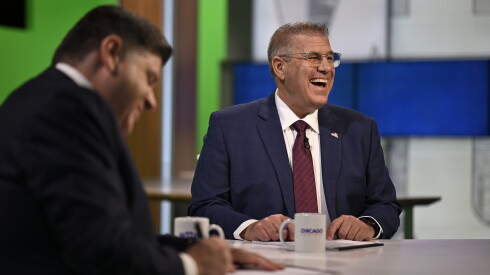
“I’m just glad I’m not going to be known as the governor that lost the Bears,” Republican gubernatorial nominee Darren Bailey said in a debate last week with Gov. JB Pritzker, seemingly resigned to the team’s Indiana defection.
But as the Nov. 3 election nears, Pritzker has indicated he’s increasingly confident he and other Democratic leaders in Springfield can get the best of both worlds while carrying a stadium deal across the goal line.
The incumbent’s optimism seems to be cresting for a resolution arriving five years after the Bears’ drive for a new home began, 11 months after the team’s first Hoosier threat — and a few weeks after the polls close.
And it could even happen in Chicago, Pritzker says, which had been all but eliminated from the Bears’ conversation for the past year in favor of Arlington Heights.
“I believe that in November, we’re going to be able to get something done to keep the Bears in the state of Illinois,” Pritzker said. “But I’m not going to do it at the expense of the taxpayers.”
Convenient timing, if you ask Bailey, who’s trying to win over voters himself in his second bid to unseat Pritzker. Lawmakers return to Springfield two weeks after the Nov. 3 election.
But the GOP challenger’s proposal to keep the Bears in their home state sounds remarkably similar to ones Pritzker has supported over his tenure. The same goes for independent gubernatorial candidate Collin Corbett, who agrees it should be a priority.
“If you’re ever going to turn around the reputation of a state like Illinois, the Bears are one business, but they’re a very public and a very loud business,” Corbett said. “We need to show that we’re open for business, that we want to grow, and no, that doesn’t mean you’re going to get a big, sweetheart deal.”

Another tone shift in stadium talks
Pritzker has rejected the prospect of any giveaways for the Bears since the McCaskeys entered a deal to acquire the old Arlington International Racecourse property in 2021.
But the governor’s tone changed considerably after the team’s threat last fall to move to Indiana, following years of Chicago legislators rolling their eyes at overtures for a bill affording the Bears long-term property tax breaks on the 326-acre northwest suburban site.
Pritzker backed off previous suggestions the Bears should pay off lingering debt from Soldier Field’s 2003 renovation and began emphasizing his support for public funding of potentially hundreds of millions of dollars’ worth of infrastructure upgrades around a potential dome.
Most importantly, Pritzker took on a more active role in stadium negotiations than the passive presence from his office that lobbyists and some legislators close to the discussions had privately grumbled about for years.
The governor is driving the talks now, meeting again earlier this month with NFL Commissioner Roger Goodell, whose repeated visits to Illinois might suggest the league’s not thrilled at the prospect of breaking ground on a Hammond dome.
Pritzker has supported the broader concept of allowing the Bears to negotiate a discounted payment in lieu of taxes (PILOT) with local governments. The Illinois House passed such a bill this spring, earning critical support from Chicago Democrats because it would’ve shared proceeds with homeowners as property tax rebates — but those returns were deemed “negligible.”
The Illinois Senate passed a separate bill that would allow municipalities to create their own stadium authorities to negotiate terms of a publicly owned stadium, but it crumbled in the waning hours of spring session without a vote in the other chamber.
Sources familiar with the negotiations say the conversation has shifted toward the stadium authority model. That would mean no tax bill for the Bears — and it’d keep the door open to Chicago, providing vital cover for city legislators loath to pave the team’s path to Arlington Heights.
While there hasn’t been a clear breakthrough, optimism is growing for a bill to move by January’s lame-duck session, if not this fall’s veto session. Pritzker raised the stakes by taking the under on that timeline.
“The legislation that is being discussed now would give the option for the possibility that there would be a stadium built in the city or in Arlington Heights,” Pritzker said last week. “We want to keep them in the state of Illinois. If we give them those two options, I think that would be satisfactory.
“In the end, this is up to the Bears,” he added.
A familiar Bears stadium pitch from Darren Bailey
Bailey, taking another shot at the gubernatorial end zone four years after losing to Pritzker, suggested a Bears move to Indiana is a fait accompli based on his own conversations with Indiana Gov. Mike Braun. Hoosier lawmakers rolled out the red carpet in February with a generous legislative package that would put $1 billion into a Bears dome.
But last month, Bailey wore a Bears jersey while offering up his own so-called “I-Formation Plan” to entice the team to stay in-state.
The crux of the downstate proposal is a PILOT incentive similar to what Pritzker has supported, which passed the Illinois House but was dead on arrival amid stiff opposition from Chicago Democrats in the state Senate.
“Rejecting a bad deal does not excuse JB Pritzker from finding a better one,” Bailey said. “That’s what governors are elected to do. They’re supposed to be bringing people together. They’re supposed to negotiate. They’re supposed to protect taxpayers, and they’re supposed to deliver a solution. Instead, JB Pritzker has allowed years to pass while Indiana aggressively pursued our team.”
Bailey’s running mate, Aaron Del Mar, said Pritzker should have been able to whip the votes.
“JB Pritzker, who is the leader of the Democratic Party, is the largest funder of the Democratic Party of Illinois, needs to start putting some political pressure on his own people,” Del Mar said.
Independent take
Corbett, the former Republican strategist mounting a moderate independent campaign, agreed the onus was on Pritzker to get Chicago Democrats in line with a PILOT model.
“His entire economic development strategy is giving these big taxpayer benefits to big corporations, so I do believe it’s him talking out of both sides of his mouth,” said Corbett, a Palatine resident.
“He knows that if he wants to run for president and win a Democratic primary, he can’t be the guy who gave a billionaire sports franchise a tax break. And that’s the problem here — politics is what has gotten in the way.”
That means twisting some legislative arms in the city, for the sake of not sending a $9 billion franchise across the border.
“If we’re one Illinois, and what’s good for Chicago is good for the rest of the state — well, then that has to go in both directions,” Corbett said.