SALT LAKE CITY — The rate at which Blackhawks rookie Roman Kantserov has learned English over the past couple years has amazed everyone.
By chatting with two Americans on his Russian team, watching American movies and simply dedicating himself to it, the 22-year-old native of Magnitogorsk — an industrial city near the Russia/Kazakhstan border — has picked up the language remarkably quickly. He’s fully conversational at this point.
But the past few weeks, as the Hawks raced through an intense training camp and then hit the road for their opening trip, represented the final boss of English for Kantserov.
It’s one thing to order coffee or joke around with teammates. It’s another to decipher coach Jeff Blashill’s specific drill instructions in a loud, chaotic rink environment when there are consequences for messing up. “Hockey English” can be its own language.
“Sometimes it’s so hard because you don’t know these things,” Kantserov said Wednesday. “Every day, you learn and learn. You just listen and hear so many times one word, and you analyze, ‘What does this mean?’
“Now I know ‘hook and ladder’ and ‘rims’ and ‘regroups.’ It’s good. We help each other. Guys will help me. I ask [Nick Lardis] what we do because it was so fast. He says, ‘Similar exercise.'”
Swedish rookie Anton Frondell found himself in the same situation when joining the Hawks last spring. Although his English was also remarkably good, he still encountered an overwhelming amount of newness.
When the Hawks flew to Seattle in April, for example, he wasn’t sure where they were. Once they made it to San Jose — which he had heard of — he realized they must be on the West Coast. Now, he uses his Snapchat map to discover the locations of cities like Winnipeg (where his good friend Viggo Bjorck now plays).
He also had to memorize the team’s daily routine on the fly. What time does the bus for morning skate leave? What time does the team go on the ice for warmups? Navigating those logistics becomes second nature for veteran NHL players, but it wasn’t simple for Frondell at first.
Understanding the barrage of English hockey terms posed another challenge. And even though Frondell’s month of experience last spring helped him build a foundation, he and Kantserov have been sharing notes this fall.
“For me, it’s easy to talk to him because we are on the same level — kind of — with English,” Frondell said. “I still don’t understand everything that every guy says in here, so we’re probably on the same page.”
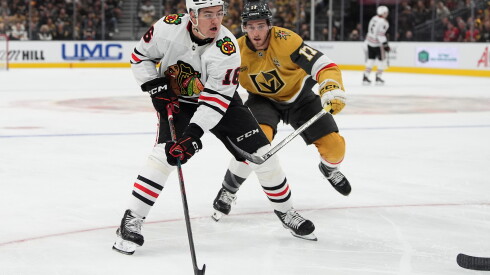
They’re humble about it, but they’ve awed everyone with their ability and eagerness to learn.
Patrick Kane has brought up Kantserov’s communication skills several times. Ryan Donato, asked last week which youngster had stood out most, singled out Frondell and his trustworthy “veteran-type presence.” Coach Jeff Blashill has been impressed, too.
“We try to be consistent in our verbiage,” Blashill said. “If they don’t understand something in our verbiage, they ask. They’re both really dialed-in young guys. They’re not afraid to ask questions, and they seem to learn quickly.”
It works to Kantserov and Frondell’s advantage, of course, that they’re naturally outgoing, talkative people, regardless of language.
They’re eager to socialize, even with reporters. Kantserov, coming off his “emotional” NHL debut Tuesday, apologized Wednesday for his occasionally redundant answers.
“I need to improve my [grammar], and I need to learn some other words,” he said. “Because I think in every interview, I’m asked similar questions and I answer in the same words.”
He added that he should “watch more movies,” referencing the fact that much of his original English knowledge came from watching Transformers and Spider-Man.
What about Levshunov?
It can be tiring to talk in your non-native language all day, every day, so it’s nice for Kantserov to have Belarusian defenseman Artyom Levshunov on the team. When they talk to each other, it is in Russian.
But Kantserov jokingly chided Levshunov for not being particularly helpful when it comes to understanding what’s happening in practice.
“Arty is here, but sometimes he’s so quiet,” Kantserov said, grinning. “Maybe I ask him something and he won’t tell me what to do. I ask him what to do in a drill, and he’s like, ‘You can see it. It’s not hard. It’s easy. You can see it by yourself.’ I say, ‘OK, brother. I figure out. Don’t worry.'”
Reminiscent of Panarin?
The on-ice chemistry between Kane and Kantserov — although they’re now split apart in the line combinations — has reminded some fans of Kane’s natural connection with former Hawks star Artemi Panarin.
Kane doesn’t really see it, though. For one thing, Panarin is right-handed and Kantserov is left-handed. Their playing styles differ, too.
“[Panarin was] very puck-dominant, puck-controlling, able to control the game with the way he carried the puck,” Kane said. “Roman’s got that ability, but he’s more of an off-the-puck guy. He can find open spaces and find ways to get his shot off.”