Mica Cole stood on the stage, with tears in her eyes. The occasion was TimeLine Theatre’s first public showing of its brand-new building — the culmination of years of near-constant fundraising, nomadic productions, unexpected delays and stress-inducing construction woes.
A week later, on a recent tour of the building, Nick Bowling gushed about everything from the walnut bar to the vintage lamps in the toilet stalls. And PJ Powers raved about the building’s views as if he were looking out on the Taj Mahal, instead of a Red Line L stop.
To appreciate all of this emotion for TimeLine Theatre’s new $46 million home in Uptown, set to open May 6 with Henrik Ibsen’s “An Enemy of the People,” you have to understand where the company has come from.
For almost three decades, the ambitious, history-centered company had to make do with the second-floor of a 110-year-old church building in Lake View — along with dodgy electrical wiring, no elevator, toilets that didn’t always work and no central air conditioning.

After a decade-plus search for a new home, the company finally bought a building in 2018, only to have the pandemic hit, causing TimeLine to go dark for nearly two years. The cost of construction more than doubled from the original $20 million price tag, due to inflation, supply-chain issues and other factors. But donations kept coming in; the largest amount, $10 million, came from the city of Chicago.
“This space is going to allow the art to expand beyond our imagination,” said Cole, TimeLine’s executive director, on a recent weekday afternoon. Powers, TimeLine’s artistic director, Bowling, the company’s associate artistic director, and Cole gave me a tour of the new five-story theater building at 5035 N. Broadway — gleaming and sleek, but also proudly displaying its concrete-and-brick former warehouse bones.

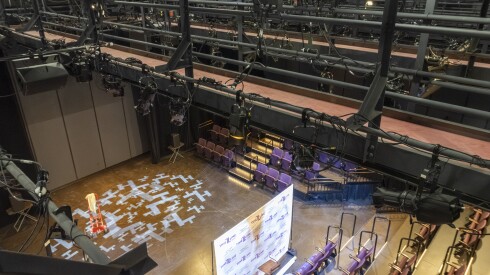
The theater seats 250 people, configurable seven different ways depending on the play, a significant jump in capacity from TimeLine’s former space, which could accommodate 99 people.
The excitement over what this new space will make possible, artistically, feels palpable. For example, the company’s theater now has catwalks, those metal bridges high above that allow designers to hang lights from a grid and also lower set pieces to the stage.
“We have the ability to re-hang a light, move a light, re-focus a light,” said Powers, the artistic director. “On Wellington Avenue, if we needed to do that, we would have to stop everything, get out an extension ladder.”
The theater also has a large rehearsal space with a wall of glass windows, giving the actors a view of Broadway and the vibrant Argyle District.


The building’s public spaces — including a first-floor bar/cafe with ample seating — come to life with quirky industrial and artistic objects that Bowling found on a far-reaching scavenger hunt.
There’s a 1950s Motorola TV set that’s been fashioned into a side table. Vintage suitcases serve the same function elsewhere in the building. Each of the 20 or so toilet stalls has a unique light fixture.
“We wanted it to feel like it was a collected history of the last 100 years,” Bowling said.
The staff are thrilled too that the theater sits directly in front of the newly refurbished Argyle Red Line stop.
“We hope that because we’re right here by the Red Line, which is this main artery through the city, that folks will come from up north from the south to see our work,” Cole said.

A hoped-for entertainment district in Uptown with the boarded-up Uptown Theatre at its center hasn’t yet been realized. Double Door, the legendary music club, had plans to re-open in the old Wilson Theater, but its owner told the Chicago Sun-Times in February that ballooning costs, among other things, means that project won’t be moving forward.
“There is already enough in Uptown that we are adding to,” Powers said. “I don’t feel like our success was contingent on those other spaces.”
The fundraising campaign for TimeLine is about 90% complete, but Powers chuckled at a question suggesting the hard work is now over. “It’s basically just feet up on that desk from here on,” he said sarcastically. “No, because everything is now at a far greater extreme. Our need to raise funds does not end because this building is constructed. Our operations are doubling” in costs.
The war in the Middle East and the potential impact on the local economy is a worry, as well as ongoing concerns about shifting audience habits following the pandemic.
“They are real and formidable forces,” Powers said. “But the fact that at least three theaters are opening a new building [in the Chicago area] in the next year … really speaks to the unique quality of Chicago theater when we talk about our peers in some other cities. It speaks to the investment that the city and state have made in many of these buildings, and it speaks to the investment that individual philanthropists have made.” Northlight Theatre is constructing a new building in Evanston, and Steep Theater broke ground on its new home last December.
All of that is what brought Cole to tears during the recent ribbon-cutting ceremony.
“Just looking out into the house from that stage, I just lost it,” she said. “It was such an emotional experience. It was a reflection, a culmination of so many years, many incredible collaborators, many artistic ideas poured into the building.”