Mayor Brandon Johnson on Monday suffered the latest in a string of City Council defeats — a loss that blows a $75 million hole in his preelection budget.
At a special meeting that the Johnson administration tried to avoid, a veto-proof City Council majority voted 44-6 to compel Johnson to apply the $75 million up-front payment from Stonepeak Partners, the New York investment firm that acquired Chicago’s parking meters, to the 2026 city budget for use as an extra payment that chips away at the city’s $36 billion pension crisis.
Without consulting the Council, Johnson decided to use the $75 million windfall to help defray the cost of the $363 million pension advance for 2027.
The police and fire pension funds most in danger of insolvency — with assets to cover just 26.4% and 25.2% of liabilities respectively — will each receive $25.12 million “no later than Dec. 31.”
The Municipal Employees and Laborers pension funds — with unfunded ratios of 28.1% and 44.1% respectively — will each receive $12.375 million, the ordinance states.
Finance Chair and 3rd Ward Ald. Pat Dowell led the negotiating team that persuaded Stonepeak to pay the city $75 million up front, and 5% of profit-sharing going forward. Dowell estimated that Monday’s vote would “conservatively” save city employee pension funds “$213 million over time.”
“For too long, one-off revenues and asset leases have been used to fill immediate, short-term budget holes at the expense of our long-term financial health,” Dowell told her colleagues.
“We are drawing a hard line in the sand — not just for today but for the future of Chicago’s fiscal management. Securing our four pension funds is not just a statutory requirement. It is a moral obligation to the workforce that keeps this city moving. I urge my colleagues to stand on the right side of history, locking this into city code, securing this additional revenue for our pensions now and for the remaining 57 years of this contract.”
For those who are “worried about the hole” created by Monday’s vote, Dowell said, “I stand ready to work with my colleagues to vet and implement any proposal the mayor puts forth to adjust his budget in response.”
“When you have a lot of debt, sometimes you have to eat beans while you’re paying off the debt,” Dowell said. “We are doing just that.”
Budget Chair and 28th Ward Ald. Jason Ervin, the mayor’s most powerful ally, tried and failed to shame his colleagues into backing off by pointing to the people programs that he said will now need to be sacrificed because of what he called the “overpayment” to city employee pension funds.
They include funding for tree-trimming, rodent control and other city housekeeping services, as well as for libraries, youth jobs, affordable housing and Chicagoans who are unhoused.
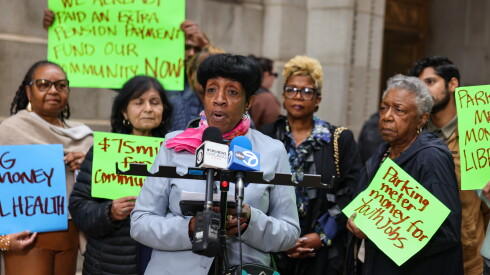
Rosie Inwang speaks at a news conference held by fellow members of the People’s Unity Platform outside City Hall Monday. The group is calling for $75 million in Chicago parking meter funds to be used for libraries, youth jobs and city services instead of extra pension payments.
Anthony Vazquez/Sun-Times
“Vote your conscience, but understand that folks are gonna lose out in this for something that we are going to, theoretically, overpay on,” Ervin said. “I don’t know anybody [who] pays two years’ rent ahead of time when we don’t have the basics in communities today. That is tantamount to what we’re doing.”
Ald. Byron Sigcho-Lopez (25th), who joined Ervin in casting one of the six “no” votes, said he was “sick and tired of coming into this chamber to decide what was already decided by the few.”
“In the budget hearings, I’ve been hearing how much we need more youth jobs. … How are we gonna pay for it?” Sigcho-Lopez asked.
After the vote, the mayor’s office released a statement saying, “Directing these dollars toward an additional payment comes with a potential trade-off for Chicagoans, putting youth jobs, homelessness services, libraries, community violence intervention programs, and basic neighborhood services at risk. The Johnson administration will continue fighting to protect them and ensure our neighborhoods receive the resources they need and deserve.”
Ald. Brendan Reilly (42nd) rejected what he called the “false choice” between dire budget cuts and fiscal responsibility.
Monday’s vote marks the latest in a string of Council defeats for Johnson, who has struggled to pass his last two budgets, issued four mayoral vetoes, cast several tie-breaking votes and has been forced accept a Zoning Committee chair he did not choose.
Even more troubling for the mayor is the $75 million hole created by Monday’s vote that is almost certain to get bigger.
If 29 alderpersons make good on their threat to reject Johnson’s revived corporate head tax, the budget gap will be $176 million. If they reject or reduce Johnson’s plan to raise the Chicago tax on equipment rentals and cloud computing to 20% or oppose his plan to borrow $480 million for police settlements, the gap could top $400 million.