The Venezuelan man believed his case for asylum checked all the boxes to let him stay in the United States.
He had proof of how badly local police hurt him when they kidnapped and sodomized him, the nadir of months of harassment. As a gay man, he’s considered part of a protected class. And after he reported the assaults, the officers swore revenge.
“They will kill me, these police officers,” he testified in Spanish in August. “They’ll know when I am there” in Venezuela. “I don’t want to return.”
And yet, the federal immigration judge assigned to hear his case in downtown Chicago was not convinced. Among the doubts he cited in denying the case: he couldn’t believe that the two officers piled onto a single motorcycle with their victim. He said the documents lacked crucial details, and ultimately determined that the police, though in uniform, were acting on a personal grudge rather than official actions.
Judge Matthew C. Beese, a first of many hires to Chicago’s immigration court during President Donald Trump’s second term, has one of the lowest asylum approval rates in Chicago now, contributing to a larger trend nationally of plummeting rates.
In Chicago, the asylum approval rate is just 3.3% so far this year; last year it was 14.6%. The national average dropped to 2.1%, down from 8.8%, according to a Chicago Sun-Times and WBEZ analysis of immigration court court data.
Asylum is historically a hard-won way to stay in the United States, requiring evidence of persecution back home that specifically targets protected groups of people, such as political dissidents or ethnic minorities. Escaping general dire conditions such as poverty, violence or a failing government was never sufficient to win asylum protection.
Since January 2025, when the newly inaugurated president immediately began ramping up deportations and removing millions of immigrants, his Department of Justice has foisted a major shake-up onto the immigration court it oversees. Veteran judges with deep backgrounds as immigration lawyers have been pushed out and replaced by new hires. A national social media campaign to recruit new judges continues to frame the role as a “deportation judge.”
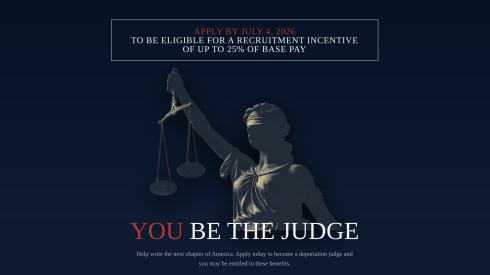
In Chicago, many of the recent hires used to work in military and administrative law, rather than immigration law, and as such, they’re taking the bench largely without important context about the home countries immigrants have fled.
Immigration judges have also been saddled with heavy caseloads, narrowed rules aimed at granting fewer asylum cases, and a new urgency coming from Washington to wrap up cases for migrants from certain countries, lawyers and recently ousted judges say.
They also worry that due process in Chicago’s immigration court is slipping away.
“When people talk about justice in our immigration system, I think the important piece is whether someone has had their day in court,” says Eva Saltzman, one of the most recently fired judges, “and I think whether individuals receive due process is a reflection of the integrity of the judge and the integrity of the government overall.”
Asked for an interview, the Department of Justice instead sent a prepared statement from its press office declining to comment on personnel matters.
“Reducing the immigration court backlog remains one of the highest priorities for this administration. The Justice Department is restoring integrity to our immigration system by hearing cases fairly, expeditiously, and uniformly, in accordance with the law,” it read.
“This Department of Justice continues to bring on talented legal professionals who are committed to protecting national security and public safety.”
No background in immigration law
Chicago’s immigration judges have seen a revolving door during the second Trump administration. Amid a flurry of changes by the Justice Department, a few experienced judges accepted early retirement or resigned, but at least six more in the court of about 20 have been fired without explanation, they say.
And for seven of the 10 judges newly appointed to hear cases in Chicago, their promotion appears to mark the start of their practice in immigration law.
A review of public records shows this holds true for Judge Beese, the Venezuelan man’s judge, who was appointed last October. Though a seasoned attorney licensed since 2003, Judge Beese’s Justice Department bio shows his seven years as a judge were spent as a municipal judge first in an Oklahoma town of about 500 and then as an administrative law judge for Oklahoma’s state regulatory commission governing utilities and oil and gas.
As a lawyer, he was a longtime deputy city attorney for Muskogee, Oklahoma, and had practiced family, criminal and general law around Rockford, Illinois.
Other new hires came from careers as military judges and as prosecutors. The three that have a background in immigration have worked for U.S. Immigration and Customs Enforcement.
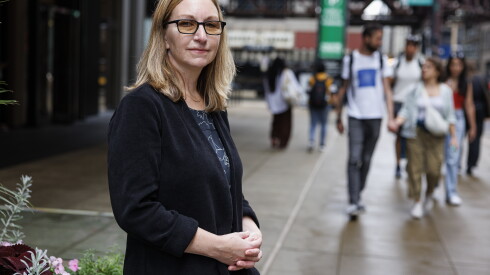
Jennifer Peyton, Chicago’s former assistant chief of immigration court until she was fired in July 2025, says she’s found herself explaining facets of immigration law to some of the new judges now that she’s representing immigrants again in private practice.
She says she’s had hearings with some of the newer judges, including ones in Chicago, where they’ve said things that run counter to immigration law. “And I’m like, ‘that’s impossible because of the posture of this case, like that can’t happen,'” Peyton says. “I was lucky because I focused my entire career on immigration, so I had a pretty good grasp of [immigration law] going in.”
The new judges hired since 2025 in particular are driving down the asylum approval rate. Of the 1,638 asylum cases brought before them through August, they’ve granted just 25. That’s a 1.5% approval rating.
Beese, for example, has granted just 13 cases of the 802 that have come before him, and denied 212. He has ruled 511 of them “abandoned” — which could mean the immigrant didn’t show up in court or didn’t complete requirements such as being fingerprinted or submitting evidence, setting them on a path to deportation.
Two of his new colleagues with more than 500 asylum rulings between them since their May appointments have yet to grant any asylum petitions at all. According to their Department of Justice biographies, both were former prosecutors and ICE lawyers, Shawn J. Abraham for six months in Chicago and Jaime Poarch for seven in Texas.
The Sun-Times/WBEZ analysis used data published by the Executive Office for Immigration Review, the government’s name for the immigration court, as collected by the Deportation Data Project, through the end of August.
Lots of rule changes, lots of firings
Saltzman was one of the two judges fired in July, as asylum cases in Chicago peaked. One Thursday afternoon, as she was hearing cases, she says a brief email landed in her inbox telling her she was done. An immigration judge since 2016 with positive performance reviews, she was assigned to cases for immigrants in detention centers.
She also suspects her appointment by the Obama administration was a motive for her firing, saying in an interview, “I have seen that those not appointed by this administration were more quickly terminated.”
The firings posed one kind of pressure. Then there were policy changes for how judges could decide an asylum case, narrowing the grounds they could use to find a person eligible — or speeding up deadlines.
“What I did see, of course, was a lot of decisions from the Board of Immigration Appeals clarifying who is eligible for different forms of [asylum] relief,” Saltzman says, “and so a case that I might have seen three years ago, where it appeared clear that that individual had established their eligibility for asylum under the current cases that have been published by the Board of Immigration Appeals, that individual is no longer eligible for asylum, and so I did find myself in accordance with the law deciding cases very differently than I may have two or three years ago.”
In late June, Judge Elizabeth Treacy resigned under duress, saying she was overwhelmed with cases and “uncomfortable” rule changes.
“Suddenly we would receive emails, and I was never explicitly told why,” Treacy says, “where ‘Okay, here’s the number of cases; these must be heard by X date, must be completed by this date,’ without an explanation as to why.” Somalis, for example, who’ve been repeatedly vilified by the president, suddenly had their hearing dates moved up, cutting their time to gather evidence.
The changes felt wrong for Treacy, who had worked on the enforcement side of immigration, as a lawyer for ICE in 2023, when she was promoted to judge.
“The job that I left was not the job that I applied for,” she says. “I had worked for a long time with the goal of becoming an immigration judge… But in the last two years, the job just drastically changed.”
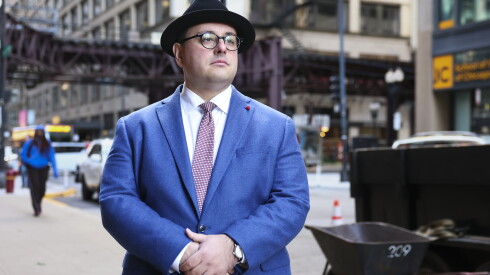
Veteran immigration lawyer Andrew Sidea also has watched changes that sounded positive play out.
That included prioritizing families seeking asylum, which ended up curtailing the time clients of his — indigenous Bolivian political dissidents — needed to gather evidence from home. Their petition was denied in July.
He’s seen judicial discretion get tightened, tying judges’ hands. And overall, asylum seekers from several Central and South American countries — such as Venezuela, Honduras and Nicaragua —now face only a small chance of having their applications approved.
“If you really wanted to sort of see, what does it mean to be an immigration judge in the second President Trump era, any of the judges that have been there for a year or less will give you a very good idea as to what the judges are being told and trained by the Department of Justice,” Sidea says.
Saltzman sees patterns that mimic trends in the federal government.
Women have been “fired or terminated without cause in the Chicago immigration court since this administration began,” Saltzman says. “There have been during that time frame no male judges terminated. There were, I believe, the hiring of two new male judges announced the day before two of us female judges were terminated. So that is what it is.”
Currently, the Chicago court lists 20 judges, including an assistant chief and backup assistant chief; 14 of them are men. In January 2025, the reverse was true. Of 22 listed then, 14 were women.
Due process under threat
The churn has immigration court veterans worried that the judges’ ability to work independently has been under threat.
That puts due process for immigrants at risk too, Treacy says.
“I have worked under many different administrations, both Republican and Democrat, some are more enforcement minded, others are not,” she says, “but it always felt until now that there was some fairness, some order to what was happening, that that we were still operating within a fair system that honored due process.”
Peyton, Treacy’s former boss, is blunter, calling what’s happening, “intentional destructive acts of our administration towards the immigration courts, towards due process, and against the non-citizens.
“I’m seeing it as like a mass catastrophe against due process, finding procedural reasons to not have hearings where someone fears torture if they’re going to go back to their home country,” says Peyton, once Chicago’s assistant chief of immigration court.
“I wish that people recognize that valid claims are being set aside every day for procedural roadblocks, and that has happened so much since January 20th [2025]. And I don’t know if we’re ever gonna get it back.”