Pics or it didn’t happen. That’s the takeaway after scrolling through the collection of photos in the new coffee table book “Chicago Music, Seen.”
Across 200 pages, music photographer and Evanston native Jim Newberry corrals his most candid snapshots and telling portraits of local luminaries like Liz Phair, Tortoise, Buddy Guy and Andrew Bird to present a visual trip through Chicago’s evolving and diverse music scenes over the last five decades, from blues and rock to hip-hop and house music.
“At the time, I was just kind of shooting assignments. But looking back on it from the macro view, it’s interesting to see the different scenes and how they evolved,” said the photographer, now based in L.A.
Laid out chronologically, “Chicago Music, Seen” (out Oct. 20 on University of Illinois Press) features an impressive amount of Newberry’s work from 1987 to 2023, the same images that frequently appeared in the Chicago Reader or as promos or album artwork for local labels like Touch and Go, Thrill Jockey and DJ International Records. Each page also features commentary from journalists or stories from the subjects themselves, resetting the scene and significance of the moment captured.
Newberry’s initial inspiration for the craft came from father, James Newberry (no relation to the library) who started the photography department at Columbia College in 1967.
“He got me interested at a young age. I started shooting probably when I was 9 or 10,” Jim said.
Years later, Newberry’s high school friend Kriss Bataille was his gateway into documenting the city’s music scene. Bataille was the short-lived drummer in Urge Overkill, and when the band needed images for their “Lineman” single in the late ’80s, Newberry was recommended. That resulting photo is one of the earliest in the book; the final entry captures a new era of Girls of the Golden West in 2023.
From that pivotal first assignment, you could find Newberry hanging out at his favorite music clubs Lounge Ax and the Hideout, working from his loft studio in Pilsen or invited into the homes of legends like Mavis Staples to get the perfect shot. While he had thousands of images to choose from, Newberry narrowed it down to the best 100.
“My main criteria was pictures that I thought were good photos, regardless of how famous or talented the artist was,” he said.
Below, Newberry shares the behind-the-scenes details from some of his favorites. You can hear more when Newberry appears Saurday at the Museum of Post Punk & Industrial Music, 3319 S. Lituanica Ave. Find tickets at ppimchicago.com.

David Yow, The Jesus Lizard (1993)
“This was for a Jim Sikora film called ‘Walls in the City.’ I’m good friends with Jim, and I did stills on a bunch of his films, also, including ‘Bullet on a Wire.’ The setting is Phyllis’ Musical Inn on Division. It was a posed shot; they were planning the next shot for the film. I’m a huge Jesus Lizard fan band, and it was great to photograph David. He’s very photogenic and a sweet guy. Not the same personality as when he’s on stage.”

Eddy Clearwater (1997)
“I got this weird assignment for the in-flight magazine for Korea Airlines. They asked me to shoot a whole bunch of blues artists. Sugar Blue, in the book, was for that assignment also. I was given this shot on a silver platter because Eddy came out, dressed in his hat and brought a guitar, and I just asked him to play and sing. I like to shoot quickly, like a photojournalist, to have some spontaneity and capture a moment, so here you can see his hand in motion. … There are more than a few people in the book [like Eddy] who are no longer with us, and it was a reminder that time goes by so fast. It seems like five minutes ago when I started.”
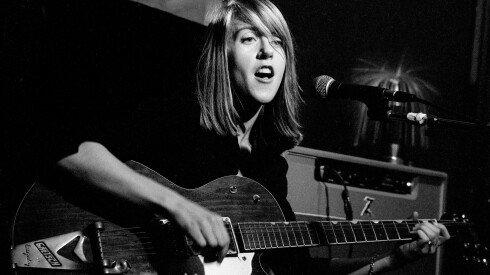
Liz Phair (1997)
“I was at Velvet Shirt Studios, owned by Brad Wood who produced ‘Exile in Guyville.’ A video shoot was going on. This was a few years after her debut, and I was hired to grab some stills for an electronic press kit. I was a total fly on the wall. I wasn’t able to set up any of my own stuff; I was simply working with the existing video crew and grabbing shots where I could. That’s how I like to work, though.”

Frankie Knuckles (2003)
“Before the picture was the cover of the book it was the cover of Remix magazine. We shot this in his home on the Near West Side. Environmental portraiture is what I grew up learning how to do, so it’s nice when someone lets you into their home because they have items in there that reflect their personality [like the ‘Godfather’ plaque and his Grammy]. I just asked him to do his thing and spin. And I remember my assistant this day was also Andrew Gill, who’s a producer on ‘Sound Opinions.’ ”
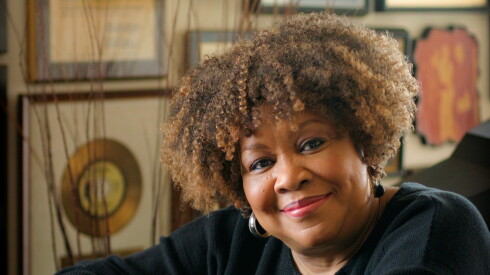
Mavis Staples (2004)
“This is another one where I was invited into Mavis’ home on the South Side, and I love it because you can see all her awards on the wall behind her. This was for the Reader, and it was still in the days I was doing film photography, so we’d go out and shoot and then would have to develop and print ourselves. I’d do the shoot, go home, develop the film in my kitchen sink and a darkroom in my apartment, and then drive to the Reader and drop off physical prints. And there was usually a really tight turnaround, so it could be stressful. … Later, I photographed her with Jeff Tweedy at the Wilco Loft, and those two had a really great chemistry where I’ve never seen Jeff come more alive than when he and Mavis were interacting and joking around and singing.“
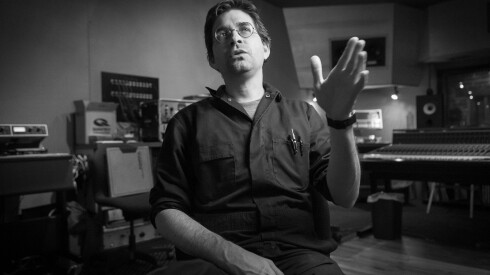
Steve Albini (2006)
“This was for a Reader article. As Steve was being interviewed, I took photos. I usually don’t shoot like that because sometimes the face of the person might look kind of weird mid-talk. But I like this one because it looks like he’s pontificating, which he was known to do. I didn’t know him well, but we did cross paths a few times over the years. I remember meeting him back in 1987 when I was doing photography for Urge Overkill, and Nash Kato and I got together at Gigio’s Pizza in Evanston, and he happened to be with Albini that day; they were roommates at the time. We all had a slice of pizza and talked about photography. Obviously, he was a hugely important person in music, and it was an honor to shoot him.”