While enslaved in North Carolina in the 1830s, Omar ibn Said wrote his story.
Scrawled in Arabic, the brief autobiography opens with passages from the Quran. It then praises God and recounts how ibn Said, a Muslim scholar, was forcibly taken from his home in West Africa and sold into slavery in the American South.
The rich text is believed to be the sole surviving Arabic-language account written by a person enslaved in the United States. But despite how rare and complex the manuscript is, it has not been widely read or taught.
That is, until Grammy Award-winning folk musician Rhiannon Giddens and composer Michael Abels, best known for his scores in movies like “Get Out” and “Us,” decided to make an opera.
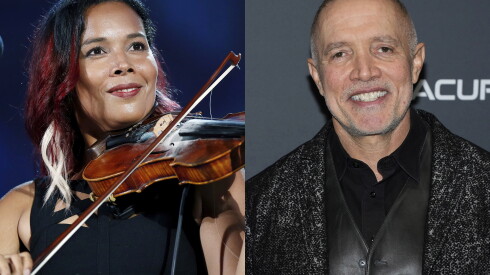
ibn Said’s story powers the Pulitzer Prize-winning opera “Omar,” which will open for a short run this week at Chicago’s Lyric Opera, a co-commissioner of the work. As the show makes its long-awaited Midwest debut, Lyric leadership is encouraging Chicagoans to read the original text and says it’s the exact right time to present this deeply American story.
When the heavyweight creative duo began working on the project in 2018, neither Giddens — a folk musician who is herself a trained opera singer — nor Abels had ever heard of ibn Said. South Carolina’s Spoleto Festival USA, a leading Southern cultural series that takes place each spring, brought the idea to Giddens, who enlisted Abels.
“His story needs to be known,” Abels said. “And people are beginning to wake up to the fact that he existed and find value in his story.”
Since its world premiere in 2022, “Omar” has been widely praised, including with the 2023 Pulitzer Prize for Music. But it has taken some time to wind its way to Chicago, after stops in Los Angeles, San Francisco and Boston, arriving here as the country marks its 250th anniversary. Lyric’s President and CEO John Mangum said it’s a fitting moment to present this “only in America kind of work.”
“I feel like there’s a bit of a paradox, but there’s no better way to celebrate the history of our country than by confronting it honestly,” Mangum said. “And I think this is a work of art that confronts the history of our country and the impact of slavery.”
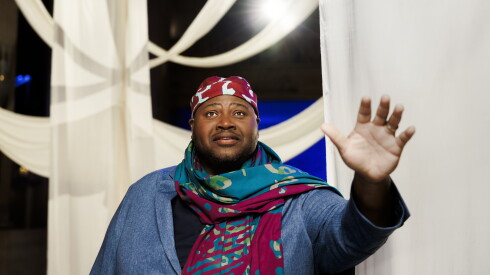
At Lyric, the titular role will be played by tenor Issachah Savage, who will be joined on stage by soprano Kearstin Piper Brown as Julie, a fictional enslaved woman who helps Omar. Hometown mezzo-soprano Zoie Reams will perform the role of Fatima, Omar’s mother. All three are appearing in the show for the first time.
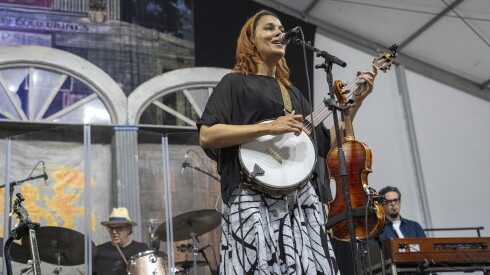
Despite Giddens’ involvement, the show is not simply a folk score adapted for the operatic stage. In fact, Giddens’ signature instrument, the banjo, is not used at all.
“Rhiannon likes to say the orchestra is the banjo, and that is actually a lot of how the orchestration works,” Abels said. “The opera is a perfect excuse to use all the different forms of American music that is really music from elsewhere, but we think of as American. And music that we don’t think of as American, but really is.”
In Chicago, “Omar” will have just three performances (as compared to the eight for the Lyric’s season opener, Mozart’s “Don Giovanni”). Mangum said the programming decision was based on lower demand in recent seasons for contemporary titles, although he said this show was “selling very well.”
Beyond the stage, Lyric has teamed up with other local arts organizations, museums and universities to encourage Chicagoans to read ibn Said’s original text through a translation available on the Library of Congress’ website. The Library purchased ibn Said’s original manuscript in 2017, after it spent decades in private collections.
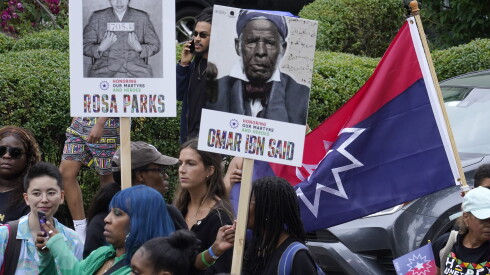
Locally, the Newberry Library has copies of about 200 narratives written by people who were enslaved. But unlike ibn Said’s account, written while he was still enslaved in North Carolina, most of those were written by individuals after they were freed, since most enslaved people were barred from learning to read or write.
“Omar’s account is really a sort of unbelievable survival and an amazing witness, and we don’t have a lot of accounts like that,” said Newberry’s Will Hansen, who curates the collection that includes plantation and genealogical records from the period of slavery.
“It is an important reminder to us how complex and rich American history is,” Hansen said. “Many people don’t think about practicing Muslims living in North Carolina in the first half of the 19th century, but they are there, and Omar proves that.”
ibn Said’s work is cautious and, despite nods to his Muslim faith, it also cites the Bible (his enslaver, James Owen, had given him a Bible written in Arabic in an attempt to convert ibn Said to Christianity). The text is also overly gracious to the Owen family, who held him as property. As composer Michael Abels put it, “the autobiography is very telling in the things it doesn’t say.”
“Omar’s biography is not a juicy tell-all in any way, and it occurs to me that maybe if I was in fear for my life and enslaved, I might be a bit hesitant to speak my mind,” Abels said.
Still, Abels said, there is something about ibn Said’s story that continues to resonate, nearly 200 years after it was written.
“It’s a story of a strange person in a strange land,” Abels said. “Omar walks among us, and there are people whose stories, in the tiny details, are different than Omar’s, but overall are exactly Omar’s story today. Now more than ever, this story needs to be told.”
Courtney Kueppers is an arts and culture reporter at WBEZ.